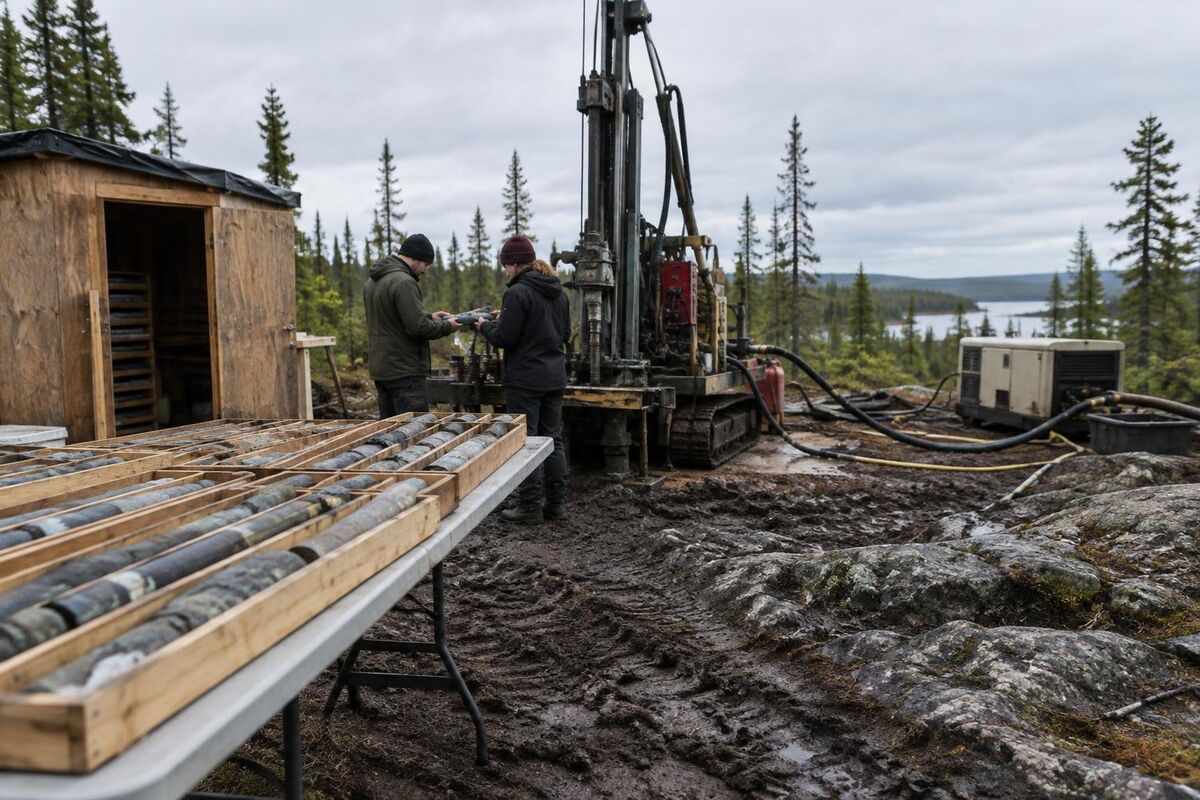
Canadian exploration companies are once again finding an audience for the oldest story in mining: capital first, discoveries later. Au Gold Corp, Canuc Resources and Core Silver Corp have secured a combined $10.8 million in financings, directing fresh money toward gold, antimony and silver projects from Havelock to Yukon.
The figures offer a useful market signal, but not a geological verdict. Funding can keep drills turning and claims advancing; it cannot, on its own, establish a discovery or predict a future share-price performance. For the TSX Venture ecosystem, that distinction is the line between renewed appetite and premature celebration.
Capital is moving back toward exploration
Discovery Alert reported that C$33 billion was raised on the TSX and TSX Venture in 2025 and the first quarter of 2026, while mergers and acquisitions increased 34%. Those figures describe a broader financing backdrop in which mining capital has become more available after a period when early-stage explorers often had to compete fiercely for attention.
The new financings fit that pattern. Au Gold Corp, trading under $AUGC on the TSX Venture, closed a non-brokered private placement raising $3,500,025 to advance its Havelock Gold-Antimony project. The announcement is covered in Kalkine Media’s report.
Canuc Resources closed a $5.99 million private placement aimed at advancing its East Sudbury Project. Separately, Core Silver Corp secured $1.287 million in flow-through financing for exploration at its Yukon Touleary Project. Together with Au Gold’s raise, those financings total approximately $10.8 million.
The Canuc transaction is detailed in the Globe and Mail’s Newsfile report, while Core Silver’s financing is described by Kalkine Media.
Three structures, three different capital-market signals
A private placement is a direct securities sale to selected investors rather than a broadly marketed public offering. It can give a junior miner access to capital on a relatively targeted basis, but the issuance of new shares or other securities may dilute existing holders. Au Gold’s financing was non-brokered, meaning the company raised the money without a brokered underwriting structure.
Flow-through financing has a different appeal in Canada. These securities are designed to pass eligible exploration-tax deductions through to investors, helping resource companies fund qualifying work. Core Silver’s $1.287 million financing therefore carries a purpose closely tied to exploration expenditure at Touleary. The structure may improve the appeal of exploration funding, although it does not eliminate geological, permitting or market risk.
Unit financing generally packages more than one security together, such as a share and an attached warrant, although the precise terms depend on the company’s offering. Gossan Resources, trading under $GSS on the TSX Venture, is raising capital through unit financing for claims. That structure may provide investors with additional exposure through attached securities, while also creating the possibility of future dilution if warrants are exercised. The assignment does not provide the size or detailed terms of Gossan’s financing.
Where the money is going
The projects span commodities with different narratives. Havelock combines gold and antimony, giving Au Gold exposure to both precious-metals exploration and a strategically important industrial metal. Canuc is directing its financing toward East Sudbury, while Core Silver is targeting the Yukon Touleary Project. Gossan’s financing is tied to claims, and Galway Metals was also identified among the companies covered in the source story; no financing terms are provided here for Galway.
That variety matters because junior-mining capital is rarely a single-commodity trade. Gold can attract attention even amid near-term price volatility, while antimony and silver carry their own supply, demand and strategic narratives. Yet a compelling commodity story remains only a backdrop. The company still has to spend the money effectively, produce credible exploration results and navigate the long timetable between claims and any potential development.
The risk hiding behind the headline
Fresh financing is constructive for an explorer’s immediate runway, but it is not proof of project success. New share issuance may dilute existing ownership. Warrants or other attached securities may add another layer of potential dilution. Flow-through funds may be restricted to eligible exploration work, and private placements can involve terms that differ materially from one company to another.
Early-stage juniors also face risks that a financing headline cannot settle: exploration may fail to deliver a meaningful discovery, projects may require additional capital, and market conditions may change before technical milestones arrive. The sector’s renewed access to funding is therefore best read as evidence that investors are willing to back exploration again—not as confirmation that every funded project will advance economically.
For the Canadian junior-mining market, the $10.8 million combined total is a small but telling flare in a dark field. It suggests capital is returning to the TSX Venture’s exploration bench, even as gold-price volatility keeps the backdrop unsettled. The next test will not be the cheque-writing. It will be what the companies can demonstrate with the money.
Bull/Bear Verdict
Bull Case: The approximately $10.8 million raised by Au Gold, Canuc and Core Silver, alongside the reported C$33 billion raised across the TSX and TSX Venture in 2025 and Q1 2026, may indicate that exploration capital is returning to Canadian juniors.
Bear Case: The financings may increase dilution, while early-stage exploration at Havelock, East Sudbury and Touleary still carries geological and execution risk; funding alone does not establish project success or future share-price performance.