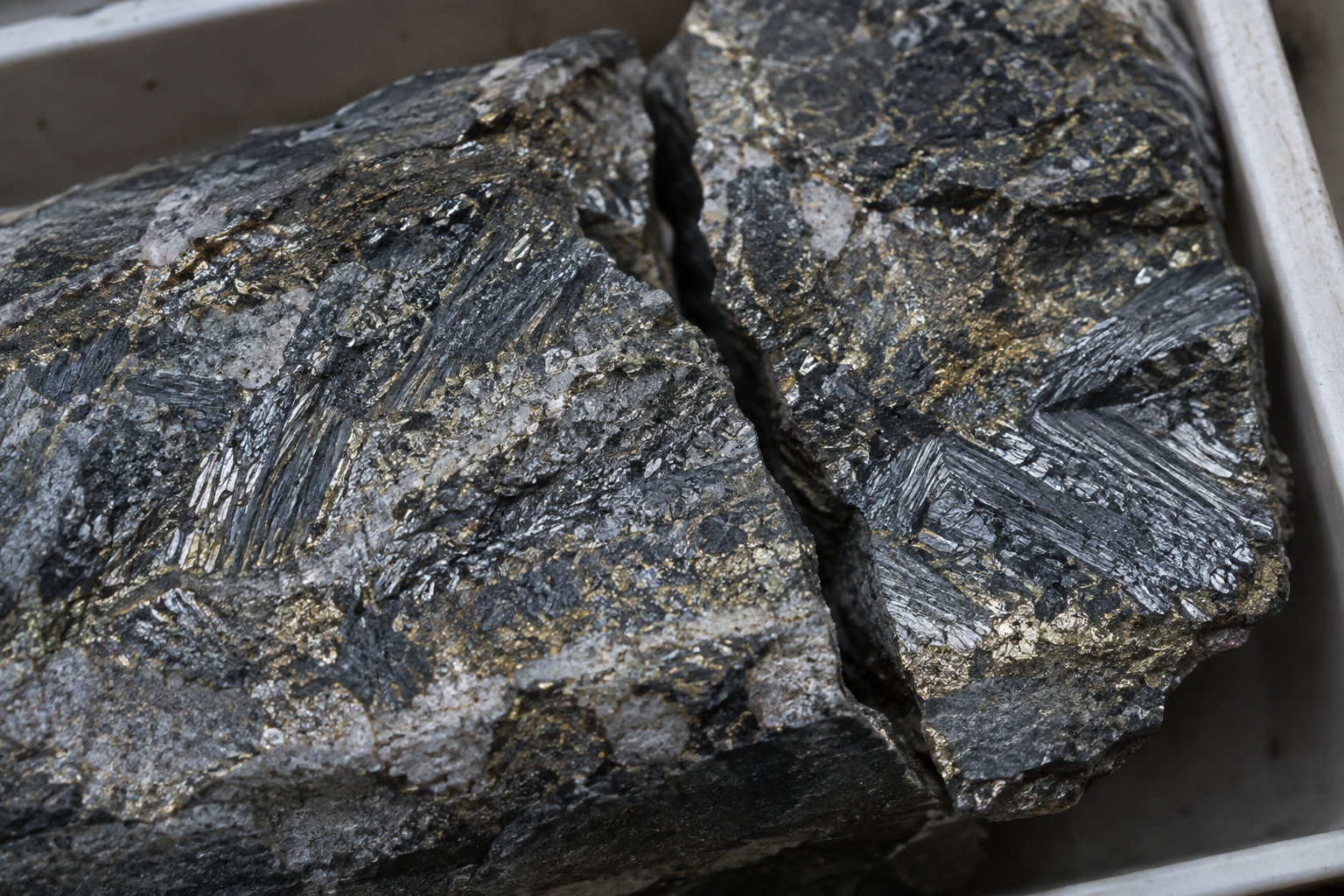
Antimony has moved from the footnotes of the critical-minerals conversation toward the center of the supply-chain stage. Nevgold Corp.’s maiden gold-antimony Mineral Resource Estimate arrives with China’s November 27 export-control deadline approaching, giving the announcement strategic relevance beyond a single exploration story.
That does not make Nevgold a replacement for Chinese supply. It does, however, place the company’s resource in a market increasingly focused on where North American antimony could come from—and how early-stage deposits might fit into a broader diversification effort.
Nevgold is listed on the TSX Venture Exchange as $NAU, on the OTCQX as $NAUFF, and in Frankfurt under 5E50. The company announced a maiden gold-antimony Mineral Resource Estimate, establishing a new data point for investors tracking the intersection of precious metals and critical minerals.
Why the antimony backdrop matters
Antimony is classified as a critical mineral, and its supply is concentrated in China. That concentration gives any Chinese export-control measure an importance that reaches well beyond the mining sector. As described in the broader antimony-market discussion, the November 27 deadline has intensified attention on the security and resilience of supply.
For North American industrial and defense buyers, the question is not simply whether antimony exists in the ground. It is whether a dependable regional supply chain can eventually develop around deposits, processing capacity and qualified purchasers. The announcement from Nevgold addresses only an early part of that chain: the identification of a gold-antimony resource.
That distinction matters. The supplied announcement does not provide resource tonnage, grades, contained metal figures, economics, development timelines or project-development claims. Without those details, the resource should be viewed as an early-stage supply-diversification development rather than evidence of imminent production.
A resource with two audiences
Nevgold’s announcement may attract exploration-focused investors because it links gold exposure with a mineral whose strategic value is being amplified by concentrated supply and export-control uncertainty. The gold-antimony combination gives the story a wider lens: one part precious-metals exploration, one part critical-minerals optionality.
The second audience may be US and Canadian industrial or defense buyers evaluating alternatives to heavily concentrated overseas supply. For those potential customers, a North American resource could be relevant as the supply-chain conversation develops. But relevance is not the same as a confirmed source of refined material, and the announcement alone does not establish that Nevgold can meet buyer requirements.
What investors can—and cannot—read into it
The timing makes the announcement noteworthy. China’s November 27 export-control deadline provides a clear policy backdrop, while antimony’s critical-mineral status explains why a new North American resource may receive attention. Still, the market must separate strategic significance from project maturity.
For now, Nevgold has added a maiden gold-antimony resource to the North American diversification story. Whether that story grows will depend on information not included in the announcement: the resource’s scale and quality, its economics, development pathway and potential connection to industrial demand. Until then, the company represents an early signal of supply-chain possibility—not a confirmed answer to China’s role in antimony.
Bull/Bear Verdict
Bull Case: Nevgold’s maiden gold-antimony Mineral Resource Estimate could gain strategic attention as antimony’s critical-mineral status, China’s concentrated supply and the November 27 export-control deadline strengthen the case for North American diversification.
Bear Case: The announcement remains an early-stage development: without disclosed tonnage, grades, economics, timelines or project-development claims, it may not demonstrate a confirmed replacement for Chinese antimony supply.