
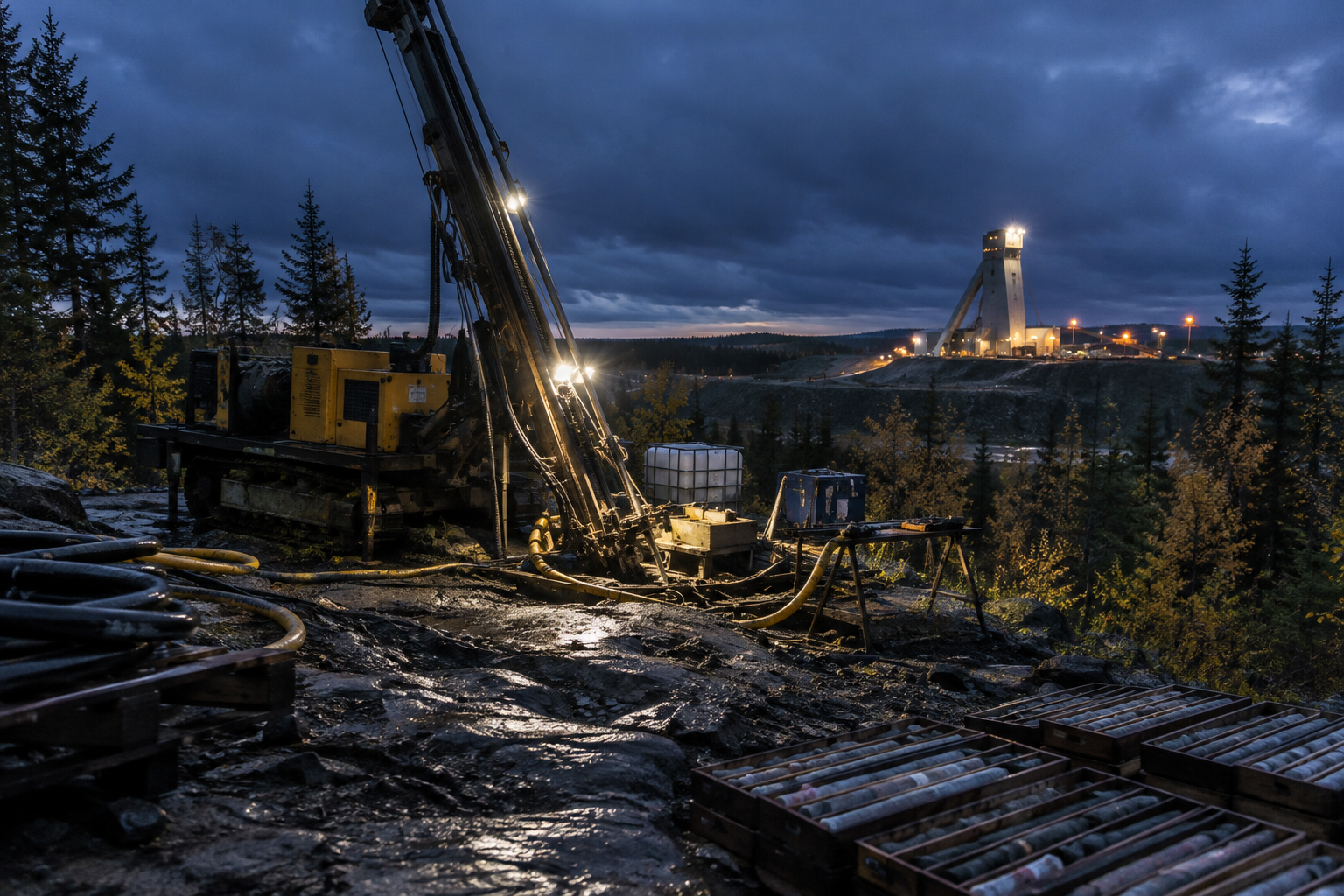
In mining, location can be the loudest part of the pitch. Discovery Mining Ltd.’s agreement to acquire the Fuller and Paymaster ground beside the Dome mine in Timmins, Ontario, is therefore less about a flashy exploration promise than about geography, consolidation and the value of controlling the right pieces of ground.
The transaction also brings a second name into focus: Franco-Nevada. The royalty company is extending its royalty over the acquired ground in exchange for a cash payment, adding a financial layer to a deal structured mostly in shares. Together, those details make this a compact example of how Canadian gold assets can be assembled—and how royalty capital can remain attached to the story.
A larger footprint in a famous gold camp
Discovery Mining, which trades on the TSX as $DSV, is acquiring the Fuller and Paymaster ground adjacent to the Dome mine. The setting matters. Timmins is one of Canada’s most prolific gold camps, and a land position beside a major gold mine naturally attracts attention from investors assessing how companies are building their portfolios.
But adjacency is not a geological guarantee, and it should not be treated as one. The transaction, as described, establishes a larger position near an established Canadian gold asset. It does not by itself provide exploration results, a development timeline, production estimates or any assurance about what the ground may ultimately contain.
That distinction is important in a sector where a map can look tantalizing long before a drill result—or even a drill program—changes the investment case. The strategic logic here is more measured: bringing neighboring ground under one owner may simplify the land package and create a more coherent platform for future evaluation.
Why the share-heavy structure matters
The deal is structured mostly in shares. That means Discovery Mining is using equity as the principal currency for the acquisition rather than relying primarily on a cash payment. For shareholders, that structure keeps the transaction tied to the company’s equity base and places the acquisition within the market’s ongoing assessment of $DSV.
It also underscores the difference between acquiring ground and proving value from it. A share-based transaction can help a mining company pursue consolidation while preserving cash, but the acquired land still has to earn investor confidence through future work and clearer evidence of its potential. At this stage, the headline is ownership and position—not a production forecast.
Franco-Nevada’s role adds a royalty angle
Franco-Nevada’s involvement gives the transaction a broader market dimension. The company is extending its royalty over the Fuller and Paymaster ground in exchange for a cash payment. The arrangement means the royalty interest remains part of the property’s financial architecture as ownership changes.
For investors tracking Franco-Nevada, the episode illustrates the appeal of the royalty-and-streaming model: exposure to mining assets can be built through contractual interests rather than direct ownership and operation of the mine itself. The royalty component also shows how a financing or asset transaction can preserve a separate economic claim around a property while the operating company consolidates the land.
That does not remove uncertainty. The value of a royalty interest remains connected to the underlying asset and its eventual development, while Discovery Mining still faces the ordinary geological and execution questions that accompany an acquired exploration position. No royalty rate, transaction value or production estimate has been provided here.
Consolidation, not a crystal ball
The Fuller and Paymaster acquisition is best read as a land-package rationalization move around a major Canadian gold asset. Discovery Mining is expanding its Timmins footprint; Franco-Nevada is extending its royalty position; and the mostly share-based structure links the deal to Discovery’s equity story.
That combination may appeal to investors who see value in assembling ground around established camps, but the facts support a disciplined conclusion rather than a dramatic one. The deal strengthens the map and clarifies the ownership structure. It does not yet answer what the ground will deliver.
For more detail on the transaction, see the source report on Discovery Mining’s Timmins acquisition.
Bull/Bear Verdict
Bull Case: The acquisition may strengthen $DSV’s position in the prolific Timmins camp by consolidating the Fuller and Paymaster ground beside the Dome mine, while Franco-Nevada’s royalty extension could add financial validation to the property’s strategic structure.
Bear Case: The deal is mostly share-based, and the available information provides no exploration results, royalty rate, transaction value or production estimate, so the enlarged land position may remain a strategic concept until further evidence emerges.